85 - How can we fix Virginia's criminal justice system?

Episode Notes

This week, we tackle criminal justice and incarceration in Virginia from two angles: for one, what injustices are criminal justice reform advocates trying to fix? For two, how can we help incarcerated people stay out of prisons and live better lives?

To answer the first question, we spoke with Rob Poggenklass, interim executive director of Justice Forward Virginia about the causes of mass incarceration and the ways that legal and societal hurdles create injustice in the law.

For the second, we spoke with John Donnelly, Vice President for Instruction and Student Services at Piedmont Virginia Community College. He runs the Higher Education in Prison program, which provides a college-level education to students behind bars, allowing them to earn a college degree while incarcerated.

To learn more:

This podcast is powered by Pinecast.
84 - What's the future of energy in Virginia?

Episode Notes

Here on the podcast, we like to keep tabs on Dominion Energy. As the largest of only 2 publicly regulated utilities in the state, Dominion is a monopoly. The caveat is that it’s a state regulated monopoly, meaning its rates and profits are monitored by a regulatory agency called the State Corporation Commission. But the SCC’s power has eroded the past few decades, thanks to a variety of bills that have been pretty soft on Dominion.

This year’s General Assembly changed that trend. In the final days of the session, the General Assembly passed sweeping legislation on Dominion. Among other things, it changes how profit margins are set and strengthens SCC oversight. That can mean pretty big things for both Dominion, and for ratepayers like us. To step us through the new legislation and its impact, we talk to Charlie Paullin, energy and environment reporter for the Virginia Mercury.

But, that’s just the latest news — and energy policy is measured more in decades than in years. One big inflection point happened back in 2020, with the Virginia Clean Economy Act. The law set a variety of energy standards, including that our energy providers be 100% renewable by 2050. But setting the standards and meeting them are two different things. So we talked to Kim Jemaine, policy director at Advanced Energy United, about the opportunities and challenges of the Clean Economy Act.

This episode is special in other ways as well. This marks the last episode of Nathan Moore as the host of Bold Dominion. Today, Nathan hands off the baton to a new host, Aaryan Balu. You’ve heard his voice before… he was Bold Dominion’s first Assistant Producer, going back more than three years. Welcome back, Aaryan!

This podcast is powered by Pinecast.

83 - Is Virginia ready for ranked choice voting?

Episode Notes

Maine does it. Alaska does it. And since 2021, Virginia can do it too, in certain city and county elections. It’s ranked choice voting, which works exactly how it sounds: voters rank their favorite candidates in order. If no candidate wins over 50% of the vote, it triggers an instant run off election. The last place candidate’s votes are transferred to the voters’ second preference. And so on, until someone wins the majority.

Proponents see it as a way to diversify candidate fields, even reduce polarization. It means that the ultimate winner will have a broader base of support, or at least more than 50% of the vote. And it also gives 3rd party candidates more of a fighting chance.

For the past few years, ranked choice voting has been used in Republican party caucuses in Virginia. And this June, Arlington County will be the first Virginia locality to use it, in their county board primaries. If all goes well, Arlington may stand as an example for other cities and counties across the state.

Sitting down with us today is Elizabeth Melson, president of FairVote Virginia, and Sally Hudson, who represents Charlottesville and Albemarle County in the House of Delegates.

82 - What did the General Assembly accomplish this year?

Episode Notes

The 2023 General Assembly session drew to a close last Saturday. And with divided majorities in the General Assembly, it was a little underwhelming. Despite a year of big, hot topic issues, little was accomplished on abortion rights, gun control, or even setting up a market for cannabis. So after six weeks, we find ourselves more or less back where we started. To understand the perspective from inside the GA, we talk with Senator Barbara Favola, who represents parts of northern Virginia. 

Things aren’t entirely over yet… lawmakers are still considering amendments to the state's two-year budget. The House and Senate have very different ideas of what to do with Virginia’s significant budget surplus. House Republicans want to give that surplus back to taxpayers through a billion dollars in tax cuts. On the other hand, Senate Democrats want to use the money to boost social programs that have been under-funded for many years. Particularly public schools. Here to walk us through this is Laura Goren, Director of Research and Education Policy at The Commonwealth Institute.

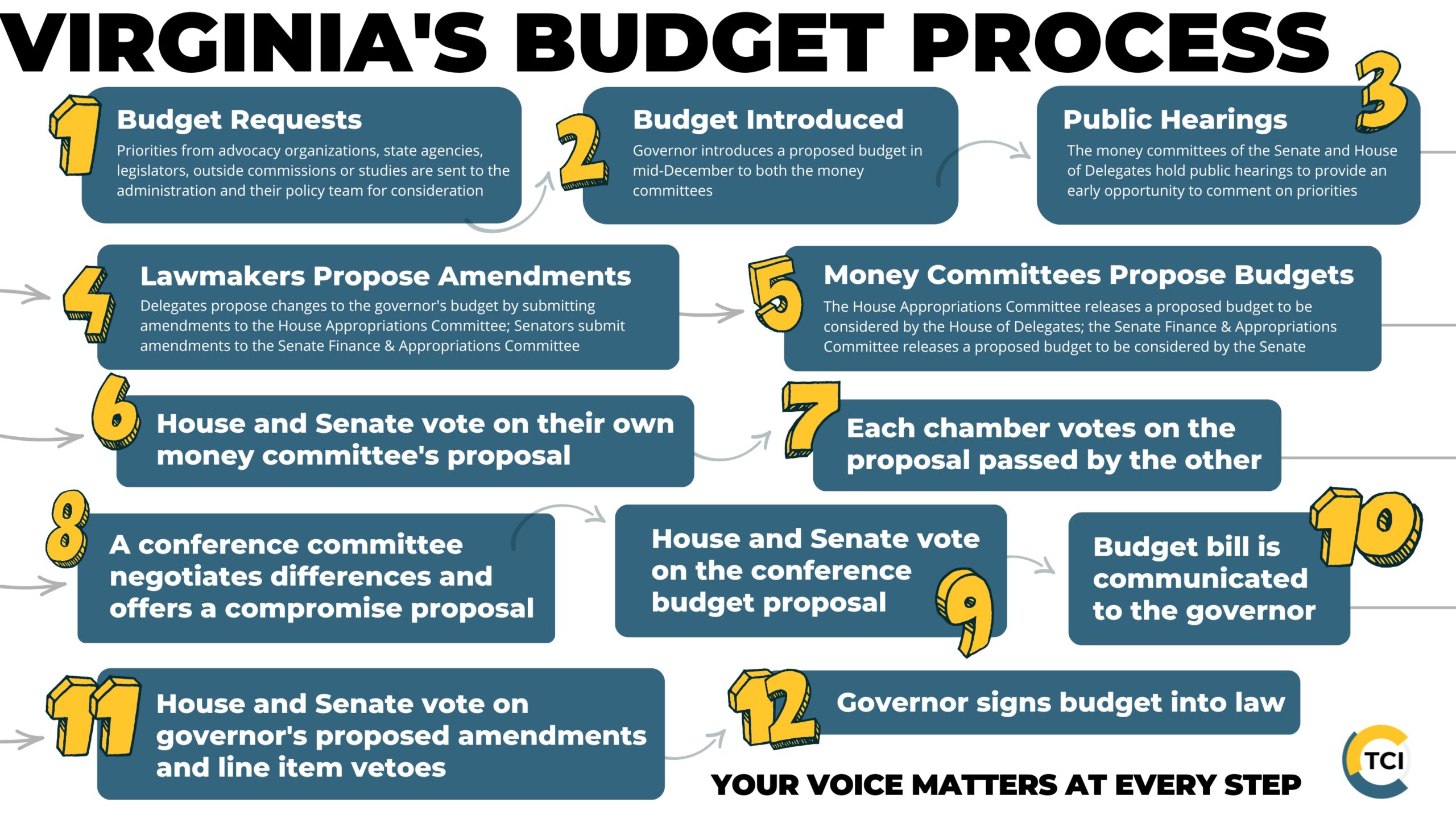
Check out more information on Virginia’s budget process and how the two proposals compare on The Commonwealth Institute’s website

81 - Why does Virginia make incarceration so expensive?

Episode Notes

In Virginia, incarceration is expensive. In prison and jails across the state, inmates have to pay to communicate with family members. They also have to pay for extra food, clothing, and sanitary products in the prison commissary. And with the highest prison wages only 45¢ per hour, the burden of paying these fees often falls on inmates’ families.

Last year, Virginia’s General Assembly organized a work group to study fees inside state prisons. They delivered a 50 page report, called “Reduction or Elimination of Costs and Fees Charged to Inmates in State Correctional Facilities.” Among other things, the report called for the elimination of fees for emails, video chats, and phone calls. It also called for the elimination of up-charges at prison commissaries and an increase in how much the state spends on prisoner meals.

In this year’s Assembly session, lawmakers introduced some bills to implement these changes, in both state prisons and local jails. However, both bills failed in the Republican-majority House of Delegates.

To help us dig deeper, we talk with Irene Shin, who represents the 86th District in the House of Delegates, and Fran Bolin, the Executive Director of Assisting Families of Inmates.

80 - Why is Virginia's government getting so little done?

Episode Notes

After two years of Democratic control, Virginia's elected government is now divided once again. The result? A lot fewer laws likely to pass this year.

This podcast started partly as a response to the media cycle that covered the General Assembly--every year around this time, there was a parade of stories about bills being introduced… and then they’d quietly die in committee. Or a bill that would pass in one chamber … and then quietly die in the other. Hardly anything ever translated into meaningful laws. Why were things like that?

This week, we talk to two state reporters about the structural and historical reasons for the General Assembly's inaction and the media coverage that follows: Peter Galuszka, a Richmond-based journalist who has covered the state for decades, and Michael Pope, a reporter covering the General Assembly and the head of the Virginia Capital Correspondents Association.

This podcast is powered by Pinecast.

79 - What's behind right-wing attacks on education?

Episode Notes

In 2021, Glenn Youngkin rode the idea of “parents' rights” to victory in his gubernatorial race. And now, Virginia conservatives have latched on to the idea as a tactic for banning books, attacking public education and starving publicly funded institutions.

The fight for public education is playing out right now in the General Assembly, as a whole host of parental rights bills work their way through the legislature. We spoke with Lisa Varga, Executive Director of the Virginia Library Association, about the chilling effect those books could have on educators--and how librarians have been dealing with the recent slew of criticism.

Then we talk to Bob Peterson, a lifelong educator, President of the Milwaukee School Board, and founder of the magazine Rethinking Schools, a grassroots magazine for social and racial justice in education. He gives us the bigger picture on the right-wing project: tracing attacks on education all the way back to 1954's Brown v. Board, the influence of dark money, and ultimate endgame of destroying the public sector.

Related Links:

This podcast is powered by Pinecast.

78 - What can we expect from the 2023 General Assembly?

Episode Notes

The General Assembly starts its 2023 session next Wednesday--with Republicans in control of the House of Delegates for the first time since this show started in 2020. In this episode, journalist Michael Pope explains what we should be looking out for as lawmakers meet next week--especially what we can glean from the governor's state budget proposal.

This podcast is powered by Pinecast.

77 - Bold Dominion's Best of 2022!

Episode Notes

As we approached the new year, we found ourselves feeling a little reflective. So we made a special episode for you. In “Best of 2022”, Nathan and Alana sit down to discuss some of our favorite episodes from this year on the podcast. Join us as we look back on the big issues of the year, from the overturning of Roe v. Wade, to Dominion Energy’s outsized influence, to how citizens can craft legislation. 

This podcast is powered by Pinecast.

76 - How does collective bargaining empower workers in Virginia?

Episode Notes

For decades, Virginia was one of only three states in the country that banned public sector collective bargaining. That meant teachers, healthcare workers, and first-responders couldn’t have a say in how their contracts were written, leading to lower pay and poorer working conditions compared to unionized workers.

But things have changed. In 2020, the General Assembly repealed that prohibition, a historic moment for workers’ rights in Virginia. 

But it’s not without its quirks. Collective bargaining isn’t required across the state — it’s up to localities to pass collective bargaining ordinances. Plus the law itself is pretty vague, leaving it up to localities to hammer out the rules and framework. Which means depending on where you live, what you can and can’t bargain over can look pretty different.

So today on the show, we’re looking at the state of public sector unions in Virginia. Helping us out is Mel Borja, Worker Power Policy Analyst at the Commonwealth Institute. We’re also joined by David Broder, president of SEIU Virginia 512, and Vernon Liechti, president of the Albemarle Education Association. 

Explore The Commonwealth Institute's interactive map of labor history in Virginia.

This podcast is powered by Pinecast.